Fenelon 1983
Fenelon, Jeannette. “The Women & Arts Festival: A Partial View.” Art Network 8 (Summer 1983): pp. 17–19. (Type: article) » Download PDFThe Women & Arts Festival: A Partial View
Women Who Want to Be … Artists
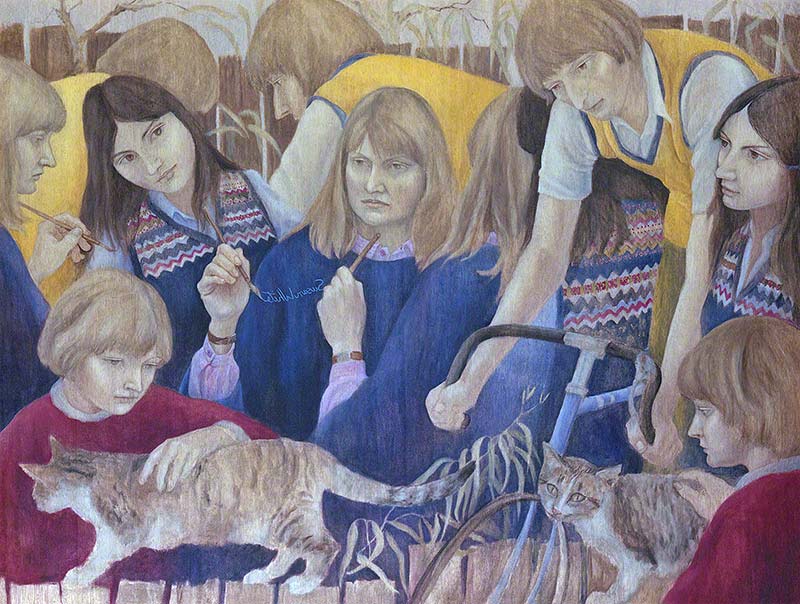
A recurring, though not dominant theme was succinctly expressed by Susan White, one of the women whose work was exhibited in the From The Inside Out show. Accompanying the black and white postcard reproduction of her painting Self Portrait With Children was the request/statement:
Don’t judge me as a mother
Don’t judge me as a woman
Judge me as an artist.
That was certainly neither the first time such a plea has been made, nor the only time it was made by artists in the Festival — either in a similar statement form, via the films on the lives of women artists, or in the discussions centred on women’s experience in varying art practices.
Ms White’s statement implies the existence of one fixed, immutable definition of “mother”, “woman” and “artist” by which one could judge her. A disavowal of one’s sex is a denial of the social context in which art is made — and consumed. But her statement can also be read as part of the current questioning of the idea of a separate “women’s art”. Ten years ago, if a painting contained a doyley or even looked as if it may have been worked “from the centre”, the tendency was to uncritically applaud it as the work of an oppressed majority — women.1 In questioning the value of such confining “definitions” of women’s art — as that identifiable (read marketable) group of works manifesting a feminine sensibility, some women have sought to leave behind the label “woman” as one which relates to their art. Allied to that implicit denial of the social construction of “art”, “artist” and “woman”, together with the underlying ideological functions of such constructions, is a refusal to engage in the problematic of meaning in relation to the images employed by women working as art makers.
Whilst it is true that the category “women’s art” is constantly being constructed, modified in a fluid continuum, it remains essential for feminists to critically discuss imagery employed by women. Such images have often perpetuated rather than challenged the patriarchal representation of Woman: woman-as-mother, woman-as-icon, woman-as-passive observer, inside, looking out. The recognition of how images of/by women can reinforce the status quo was not a concern felt by those who wished to celebrate, glorify the richness and diversity of such images. That the Festival was neither planned nor presented as a feminist strategy poses some problems in discussing it from a feminist perspective — some of those problems will become clear in a closer look at From The Inside Out: Aspects of Women’s Art and the New Zealand exhibition Mothers.