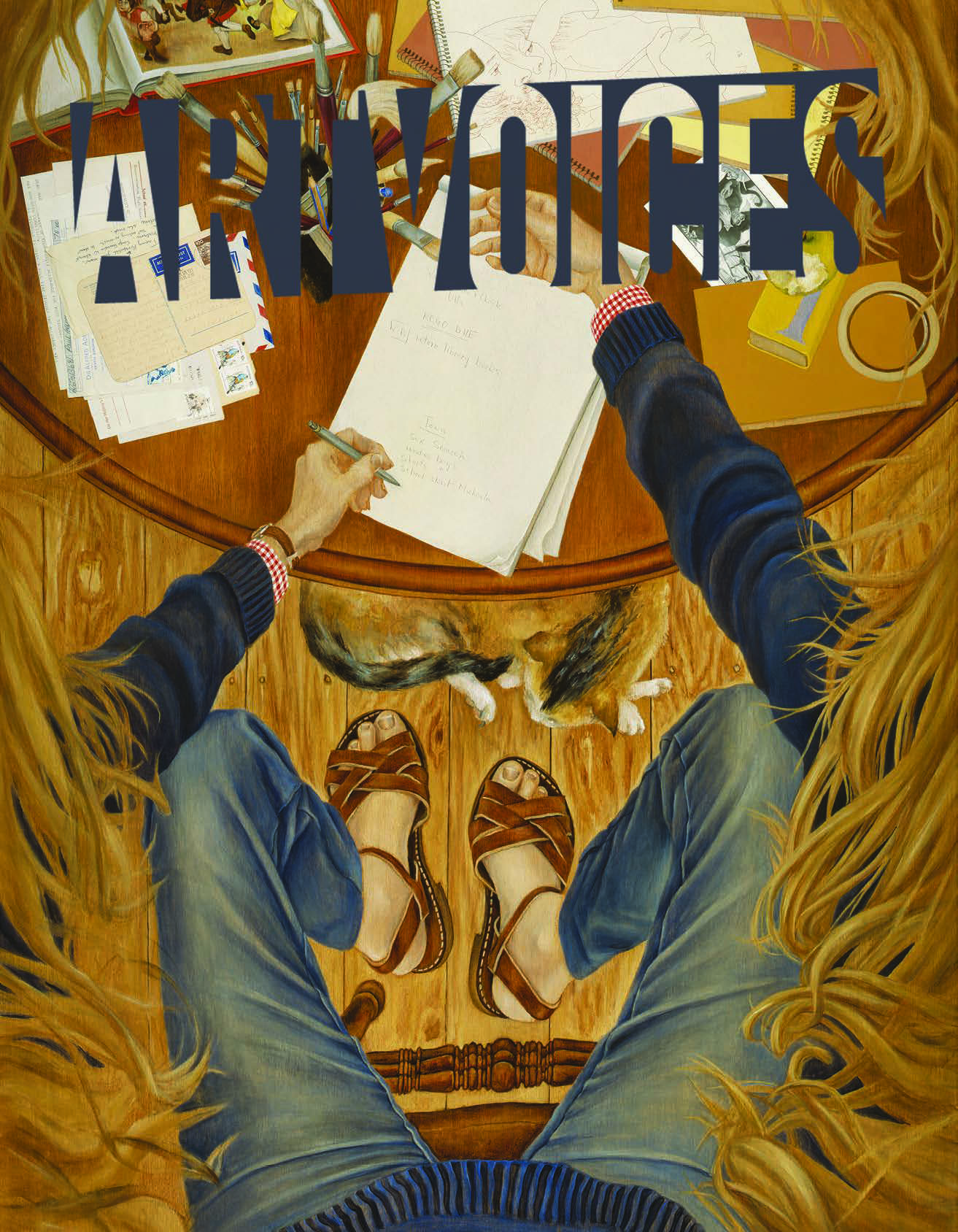
Kendzulak 2014
Kendzulak, Susan. “Cornerstone: Susan Dorothea White.” ARTVOICES Magazine, Winter 2014, pp. 1, 36–39. (Type: article) » Download PDFCornerstone: Susan Dorothea White
Susan Dorothea White was born in Adelaide, South Australia, in 1941 and grew up in Broken Hill, an isolated mining town in outback New South Wales. Raised in an artistic family, she decided by the age of fifteen to pursue visual art rather than music, although musical composition continued to influence her work. Her paintings, prints, drawings and sculptures form a visual diary encompassing childhood landscapes, family portraits, domestic life, social observation and political commentary.
White’s best-known painting, The First Supper, was inspired by Leonardo da Vinci’s The Last Supper. She replaced its biblical figures with women representing Australia’s multicultural society and positioned an Aboriginal woman at the centre. The work responded to the divisions surrounding the 1988 Australian Bicentenary and has since been widely reproduced and discussed. White nevertheless identifies the sculptures Lost for Words and It Cuts Both Ways as stronger representations of her current artistic practice.
Working across oils, acrylics, watercolour, printmaking, bronze, stone, woodcarving and mixed media, White’s oeuvre is united by her exceptional command of drawing, particularly her delineation of hands. Drawing forms the foundation of her prints, paintings and sculptures. In Lost for Words and It Cuts Both Ways, meticulously carved wooden hands convey broader social and political ideas. White describes herself as responding to the reductive process of carving and to the meditative qualities of working slowly in wood.
Her paintings range from stark social observation to humour and autobiography. Cul de Sac depicts the social realities of Sydney’s inner-city slums during the 1960s and 1970s, while Seated presents a playful self-portrait from the artist’s own viewpoint. Her accomplished drawing skills also led to the publication of Draw Like Da Vinci in 2006.
White’s knowledge of anatomy is evident in The Anatomy Lesson of Dr Freeman, which draws upon the histories of anatomical representation associated with Leonardo da Vinci and Rembrandt. White and her physician husband taught anatomy drawing classes for eight years in the dissecting laboratory at the University of New South Wales.
Her early musical training also informs what she calls “fugal compositions”, in which figures and themes recur in variations across several moments in time. White compares these visual structures to the repeated themes of a musical fugue: “Musical composition patterns are similar to painting patterns.” Through these repeated motifs, she constructs layered narratives about family, memory and lived experience.