Meloon 1982
Maloon, Terence. “Tokenism and Disorganisation Mar Women and Arts Shows.” The Sydney Morning Herald, 9 October 1982, p. 40. (Type: article) » Download PDFTokenism and Disorganisation Mar Women and Arts Shows
“It is not difficult to make things”, said the sculptor Constantin Brancusi. “What is difficult is to put ourselves in the proper condition to make them.”
Most artists, male and female, would agree that this is the case. We could also add that it is easy enough to put up exhibitions; what is difficult is to put ourselves in the proper condition to conceive of, and to participate in them.
I visited 10 exhibitions associated with the Women and Arts Festival in the last week: two at the Art Gallery of NSW, two at the Crafts Councils Centre, the Panel Show at the Australian Centre of Photography, and the exhibitions at the Coventry Gallery, Glebe Town Hall, Irving Sculpture Gallery, Power Gallery, and Sydney College of the Arts.
It would be nice to say that the general impression was that sisterhood was powerful, but it looked disunited, unfocused, disorganised and less than wholehearted in these exhibitions.
Complaints about tokenism, directed at the Premier’s Department in regard to the festival’s inadequate funding, hasty organisation and dependency on voluntary work, are justified, but don’t explain all the festival’s shortcomings. Many artists participating in the exhibitions have been tokenist too, in submitting work that is far from their best – perhaps as a gesture towards the half-arsed egalitarianism that has confused this whole event, and they have refused their work the right to stand out from the crowd.
Some of the most competent local women artists haven’t ventured out of the mixed exhibitions organised by their dealers, which is a shame, because one of the festival’s intended centre-pieces, From the Inside Out at the Crafts Councils Centre, would have benefited from their participation.
Furthermore, it was a big mistake not to structure exhibitions according to specific themes. If seven of the 10 shows I saw had their resources combined and reshuffled – I thought Sue Ford’s and the Women’s Imprint shows at the Art Gallery, and the Power Gallery exhibition were fine as they stood – there would be three or four substantial thematic shows in the offing. As things are, there is plenty of worthwhile art to see, scattered all over Sydney, although it’s a bit thin on the ground.
A crude approach to the work might be to consider its attitudes and strategies, and to divide it into groups which are feminist, feminine and neuter, but dividing lines can’t be firmly drawn.
Directly confrontational and argumentative, one of Ann Stephen’s photomontages asks the question: “Must avant-garde artists always be male and foreign?” Her own work begs the reply, no (with an English accent), or non or nein. At the Art Gallery of NSW, Toni Robertson’s suite of screen-prints is more slyly and funnily ratbagish in its expressions of resentment: the prints show scenes of ordinary women in an ordinary supermarket, which are subversively captioned and bear murderous thoughts in cartoon-bubbles.
More oblique, but just as provocative, Amanda King (at the CCC) paints still-lifes of boxes of washing-powder, oven-cleaner and iron-aid, whose garish, declamatory lettering evokes the battery of advertising aimed at dissatisfied, over-worked housewives. Their ghastly cheerfulness is like that of a commercial radio program first thing in the morning.
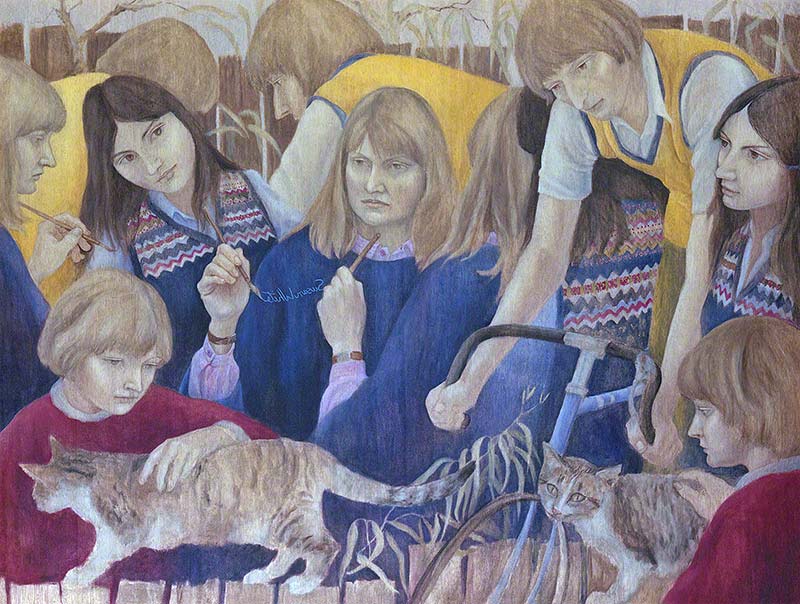
The humour is also subtly subversive in Susan White’s paintings at the CCC and at the Glebe Town Hall. She uses a host of witty devices which are equivalent to the delaying tactics used in a shaggy-dog story. Dorrit Black at the AGNSW charms you with the deceptive naivety of her little woodcut, Naval Funeral, and deftly slips in an anti-war message.
A polemical series of prints by the Women’s Domestic Needlework Group at the AGNSW takes the male-dominated art world to task for not accommodating women’s work – lace-making, crochet, sewing, knitting – in the Fine Art bracket. The prints also touch on historical aspects of the exploitation of women – in sweat-shops, and by farming-out piece-work for women to do at home – but these lose their edge a bit because of their period trappings.
An important theme in the festival, which is never developed in any one exhibition, but which recurs in all of them, is the questioning of the low status of traditional feminine crafts. This affects a lot of women’s art in a great variety of ways.
Jane Austen might have compared her novels to Regency architecture, or to the most fleet and elegantly designed modern carriage, but instead she likened them to “a little piece of ivory” which she had honed, engraved and polished.
The workmanship in a lot of women’s art is neat, repetitive, patient and genteel. Jessie Traill’s attitude to her Whistlerian nocturne, Stars of Heaven and Earth – Sydney Harbour (at the AGNSW), is reminiscent of Jane Austen’s concept of the little bit of ivory. The same would apply to the immaculately crafted minimal works by Edda Renouf, Edwina Leapman and Bridget Riley at the Power.
At the other extreme, Suzie Marsten’s painting at the CCC, and also the ones at Watters, look shockingly intemperate and impulsive in the context of the festival. Both she and Sylvia Snowden (at the Power) paint expressionistic figures and make lunging swipes with a broad, paint-laden brush, flexing formidable fore-arms to do so. Any notion of an essential femininity as something patient, nurturing and gentle is instantly scotched by these paintings.
Equally intransigent are works by Bridget Riley – there is a particularly good, recent painting at Coventry – a marvellous photo-realist still-life of two Gordon’s gin bottles by Janet Fish, and an extraordinarily powerful series of photographs by Mary Ellen of women in institutions, both at the Power, plus Jan King’s sculptures at the Irving Gallery. With these works the gender of the artists seems beside the point: their art has such a strong presence and air of finality.