Devlieger & Froyen 2006
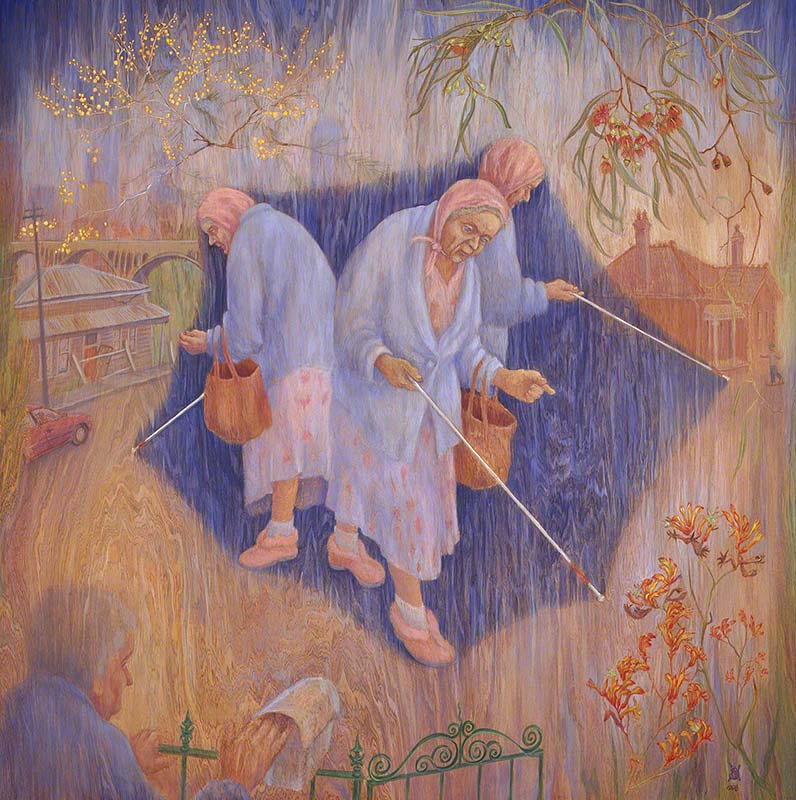
Devlieger, Patrick, and Hubert Froyen. “Blindness/City: A Disability Dialectic.” In Blindness and the Multi–Sensorial City, edited by Patrick Devlieger, Frank Renders, Hubert Froyen, and Kristel Wildiers. Antwerp: Garant Uitgevers, 2006. (Type: chapter) » Download PDFIn clarifying our understanding of this figure, we make use of a painting, "The Blind Woman of Annandale" (Figure 1), both in the interpretation of the creator, Susan Dorothea White, and in our own imaginative extension of this interpretation, for the purpose of our own work. White (2003, personal communication) has painted an old woman whom she admires for her audacity to come out of her house and into the neighborhood to go shopping, all by herself. In an encounter, the woman asks White how much further she had to go before reaching the main street, as she had lost track of the number of streets she had already crossed. White marveled at how she managed on her own and her courage in facing the danger crossing roads and was astounded when she learned that the woman lived alone. When rendering the experience, White portrays the woman as a repeated figure entrapped in a dark vacuum of invisibility. She imagined that her blindness might feel like being continuously suspended inside a dark blue cavity that moves like an invisible, impermeable membrane, isolating her from the world and rendering her vulnerable. It cannot be broken because its boundaries always move with her and her stick. The painting's context stresses the things she cannot see, such as the child in the background, the beautiful flowers (gum-blossom, kangaroo paws, and wattle), and the city skyline. Her hand reaches into the letterbox at the front gate for mail she cannot read. Her house on the left side of the painting is derelict. The texture of the grain of the wood panel is used to create a sense of the fragility of vision and the imagined instability and uncertainty of blindness. However, what struck us in the painting is not loss but the dynamism with which the woman "makes space". The mobility of her body, and the extension of her arms, aided by the white cane, transforms the space into existence, "real".
Multiple positions of the body embody the space in different directions. Movement, positioning, and tactile pointing make the space real. In other words, the painting makes clear not only the absence of vision, but also the presence of nonvisual experience (see Classen 1998:138). While the painting takes note of the losses that result from the experience of blindness, we would also like to emphasize upon the particular sensory qualities that are developed in blind people, such as the haptic, the tactile, and the auditory, which enables the making of a different version of the world. The painting not only shows how the person makes space by moving through it (see Munn 1996), it also creates locality, and by its reproduction and discussion in other media, including this book, also creates a transnational space (see also Low 2003).